Gout and Hyperuricemia
Gout and Hyperuricemia - The four phases of gout include asymptomatic hyperuricemia.
Hyperuricemia is an abnormally high level of uric acid in the blood.
Gout and Hyperuricemia
are both undissociated uric acid and the monosodium salt (primary form
in blood) are only sparingly soluble.
The limited solubility is not ordinarily a problem in urine unless the
urine is very acid or has high [Ca2+].
[Urate salts coprecipitate with calcium salts and can form stones in
kidney or bladder.] A very high concentration of urate in the blood
leads to a fairly common group of diseases referred to as gout.
This can also lead to kidney disease.
Gout has 4 phases or stages, the first is asymptomatic hyperuricemia, which s the most common form and generally not treated by a doctor until it moves into the next stage called acute gouty arthritis.
According to
MARK D. HARRIS, M.D., Wilford Hall, USAF Medical Center, San Antonio, Texas
LORI B. SIEGEL, M.D., Finch University of Health Sciences, Chicago Medical School, Chicago, Illinois
JEFFREY A. ALLOWAY, M.D., Wilford Hall, USAF Medical Center, San Antonio, Texas
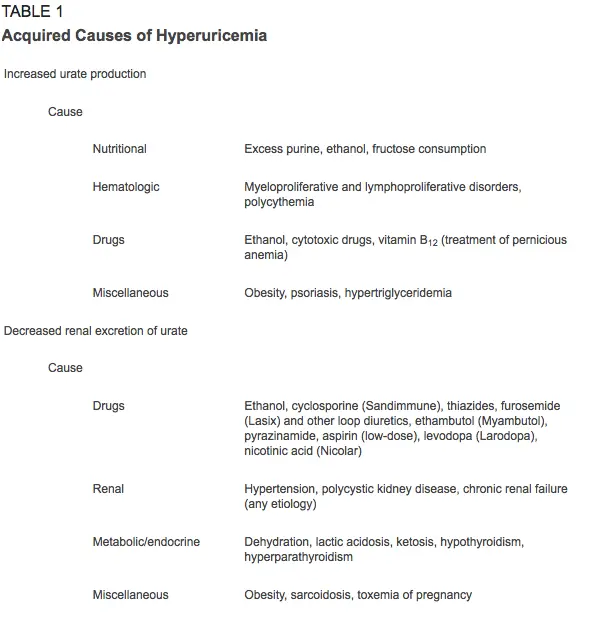
Am Fam Physician. 1999 Feb 15;59(4):925-934. The chart below shows Hyperuricemia predisposes patients to both gout and nephrolithiasis, but therapy is generally not warranted in the asymptomatic patient. Recognizing hyperuricemia in the asymptomatic patient, however, provides the physician with an opportunity to modify or correct underlying acquired causes of hyperuricemia
The incidence of gout in the USA
is about 3/1000.
Gout is a
group of pathological conditions associated with markedly elevated
levels of urate in the blood (3-7 mg/dl normal).
Hyperuricemia is not always symptomatic, but, in certain individuals,
something triggers the deposition of sodium urate crystals in joints
and tissues.
In addition to Gout and Hyperuricemia
the extreme pain accompanying acute attacks,
and repeated attacks lead to destruction of tissues and
severe arthritic-like malformations.
The term gout should be restricted to hyperuricemia with the presence
of these tophaceous deposits.
Urate in the blood could accumulate either through an overproduction
and/or an underexcretion of uric acid.
In gouts caused by an overproduction of uric acid, the defects are in
the control mechanisms governing the production of - not uric acid
itself - but of the nucleotide precursors.
The only major control of urate production that we know so far is the
availability of substrates (nucleotides, nucleosides or free bases).
One approach to the treatment of Gout and Hyperuricemia
is the drug allopurinol, an isomer of hypoxanthine.
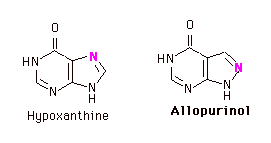
Allopurinol is a substrate for xanthine oxidase, but the product binds so tightly that the enzyme is now unable to oxidized its normal substrate. Uric acid production is diminished and xanthine and hypoxanthine levels in the blood rise. These are more soluble than urate and are less likely to deposit as crystals in the joints. Another approach is to stimulate the secretion of urate in the urine.
Summary
In summary, all, except ring-methylated, purines are deaminated (with the amino group contributing to the general ammonia pool) and the rings oxidized to uric acid for excretion. Since the purine ring is excreted intact, no energy benefit accrues to man from these carbons. Gout


Recent Articles

-
Tony
May 08, 24 08:57 PM
Hi Peter, I am a physician, had my first Gout episode last week. I was surfing through the web and happened to come across your site. I am impressed by -
What is it about Cherries?
Aug 25, 21 03:59 AM
Allopurinol worked for me, but at the expense of adversely affecting my mood.I like cherries, but getting them every day of the year is a problem.I wondered -
ACV made my gout worse...
Apr 22, 20 07:19 AM
During my first gout attack, I was in so much pain that I desperately scoured the internet for alternative cures as the colchicine that I was prescribed
